

Ruth Webber is Research Fellow, affiliated with Bradford Teaching Hospitals NHS Foundation Trust.
What does wellbeing and emotional support mean to a diverse range of young people and parents across Bradford? What does working long hours, not having enough paid work, shift work or unemployment mean for how families are able to emotionally support their children as they transition into adolescence? What about other forms of work families have to do, such as care, or household chores? In our Health Foundation-funded project ‘Supporting young Bradford’, Ketso is one way we have chosen to begin to find answers to these questions, working with young people and parents/caregivers across the city.
Summary
Our study, ‘Supporting Young Bradford’, is funded by the Health Foundation as part of a programme of research projects investigating emotional support for young people. We are looking at the impact of families’ working lives on the quantity and quality of support young people receive, as well as considering how this interacts with other factors such as household set up, ethnicity and culture, socioeconomic status, and gender. As part of the Public and Patient Involvement and Engagement work package of our project, we ran five workshops with a diverse range of young people and parents/caregivers across Bradford separately to one another.
The workshops followed the core stages of Ketso and asked:
-
- How are families already supporting their young people?
- What could families be doing differently?
- What might some barriers or challenges to these ideas be?
- What are some solutions to some of these barriers and challenges?
- What are the key goals and priorities that would allow families to provide the best support possible to their young people?
Key points and observations from the workshops
-
- The ‘think then share then discuss’ structure supported contributions from participants who otherwise may not have been confident to share voluntarily in a more traditional focus group setting. This meant we were able to hear from a wide range of young people on each of the key issues.
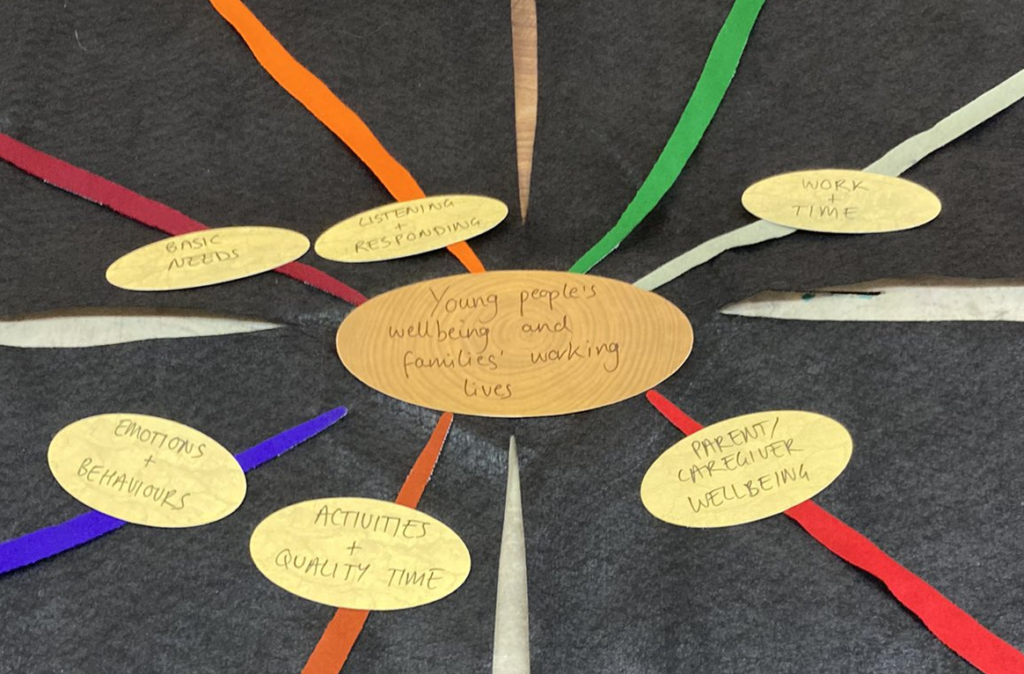
- The kit supported the powerful visual representation of data, as brown leaves of what works well and green leaves of what could work differently were clustered primarily around the themes of ‘activities and quality time’ and ‘listening and responding’.
- The blank branches allowed another core theme of ‘basic needs’ to emerge following its addition on two felts in the first two workshops, evidencing the co-productive potential of the kit. It supports conversation along themes but allows room for further additions that attendees deem to be important.
- Facilitators prompting further elaboration from participants on sparser leaves meant that explanations behind a point such as ‘bills’ became clearer and allowed the research team a deeper understanding of key issues.
- Ketso serves as an excellent way to begin to build a picture of key issues in a research project. However, given the anonymous nature of the tool, the interactions between different demographic characteristics of participants cannot be captured. In-depth interviews are therefore necessary in order to explore how different characteristics shape experiences. In the case of the Supporting Young Bradford project, we want to know more about how key dimensions such as socioeconomic status, household set up, ethnicity, and gender interact to shape families’ experiences of emotional support.
Read more below…
As a Research Fellow in the NHS based at the Bradford Institute for Health Research on the Born in Bradford (BiB) study, my current research project is seeking to answer these questions, by looking at the impact of families’ working lives on their ability to offer emotional support to their 12 – 15-year-old children. One strand of our project entailed organising and running community workshops with a diverse range of young people and parents across Bradford to explore what emotional support meant to them, using an ‘Appreciative Inquiry’ approach. Essentially this means starting by asking participants what they think is already working and using this as a springboard to think about and discuss what families could be doing differently.
I had used Ketso twice previously in a research context, to disseminate my PhD research findings and report about how cultural institutions in Glasgow can support everyday migrant homemaking in the city, particularly considering financial constraints placed on those in the asylum system, and to bring together over 80 practitioners, researchers and members of the public to think about how Manchester supports older people across the city to live well in later life. Given my experience using Ketso, I knew that it was a highly effective and dynamic tool that could support participants to share their views and experiences in a way that would ensure everyone’s voices and thoughts were heard, and think about what already works, consider future possibilities, barriers and challenges and key priorities that would have the biggest impact on how families are best able to support their young people.
We ran five workshops in total, three with young people and two with parents and caregivers, each in a different part of the city. Three of BiB’s interns have also been involved in supporting the workshops through facilitation at tables or writing up the analysis, so the project has additionally provided training and development opportunities for them to see participatory workshop tools in action in a research context.
The power of leaves
The structure of ‘think, then share, then discuss’ that each stage of the workshop follows made sure that everyone’s thoughts and experiences were heard equally, and we were not relying on people to feel confident just to talk. Even those who felt uncomfortable with talking in a group were able to write down their thoughts and place them on the felt. This meant we were able to hear from everyone, which is one of the central and essential strengths of Ketso as a discussion tool.
The themes or ‘branches’ we developed emerged from a workshop with the project group. Imagining ourselves as young people and parents of young people, we populated blank branches with themes which we then used in workshops, including: ‘Listening and Responding’, ‘Activities and Quality Time’, ‘Families’ work and time’, ‘Emotions and Behaviours’, and ‘Parent/caregiver wellbeing’. ‘Basic needs’ was added later after being identified as an important theme across blank branches in two workshops.
Seeing the wood for the trees
I was very quickly reminded of the power of the visual component of Ketso. Seeing the individual brown and green leaves become clusters, of existing assets and future possibilities around particular branches – most starkly ‘Listening and Responding’ and ‘Activities and Quality Time’ – allowed me to understand more about what families are already working to do well to support their young people.
Barriers and challenges collected primarily around branches like ‘Work and Time’ as well as some overlapping branches, in particular ‘Listening and Responding’. Seeing these key areas emerge in this way served as a very powerful means of quickly getting a sense of areas of families’ lives that will require more attention and unpacking in the interview.
Facilitators asked participants to elaborate on key points. This is essential if you want to get a clearer sense of what participants meant by particular things. Take the example of ‘bills’ below that emerged in a workshop with young people. Without gentle probing by facilitators, the context behind this would be lost, and the understanding of what this young person meant would not have been captured. It is essential to try and get a little more context behind leaves such as this, especially given the strong indication of its importance in this instance, using the exclamation point icons.
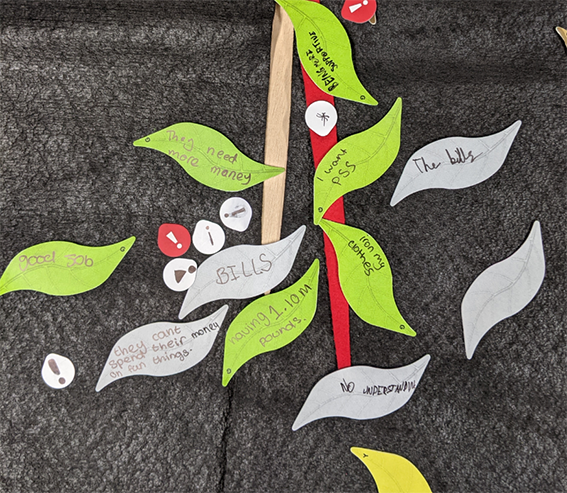
In this case, the young person explained that ‘bills’ presented a challenge to their families being able to spend money on things that young people felt supported their wellbeing, such as trips out together and gaming equipment. The increased costs of essential household items and bills caused by the current cost-of-living crisis leaves less money for these other areas of families’ lives, and it will be crucial to consider this impact in the interviews, specifically how this influences families’ decisions around their working lives.
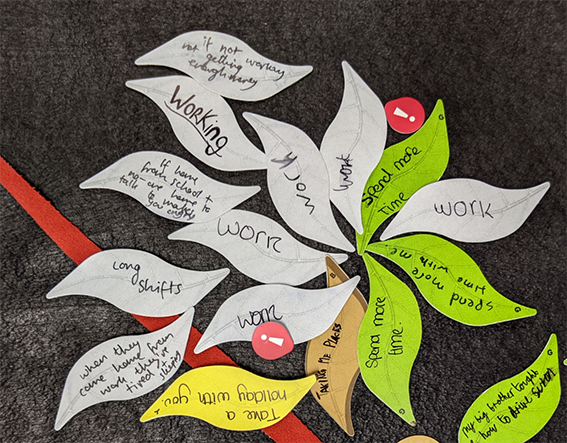
Even where there was an obvious focus on ‘work’, as in the following picture, it was only when prompted that the deeper impacts behind work as a barrier to support emerged. The young people explained that while long shifts meant there was no-one to talk to when they came home from school, or that parents might be tired and want to sleep when they returned from work, if they were not working this would increase the likelihood of not having enough money to offer other kinds of support, and cover the cost of basic needs.
The process of writing up the data captured on the leaves helped me to begin to solidify an understanding of what the key issues are for a diverse range of young people and parents across the Bradford and Keighley District. I was a floating facilitator and wasn’t part of each table’s conversations throughout the workshop, so writing up the leaves myself helped me to familiarise myself with the data. Exploring the similarities and differences between young people and parents provided valuable insight that will influence the focus of the interviews.
Reflections on analysis
The anonymous nature of Ketso given that the leaves are not ascribed to a specific person in the group, means it is impossible to know who has said what. While this is a strength from an ethical perspective in terms of ensuring anonymity, it is impossible to fully understand in a nuanced ways that different themes captured on the branches interlink with one another to influence and impact participants’ experiences. As such, while we worked to ensure we captured a diverse range of experiences from young people and parents from a wide range of ethnic backgrounds, parts of the city and a mix of genders and household types, we can’t use this data to understand patterns across these different demographic groups to say how this impacts young people’s experiences of support from their families.
However, the intention of the workshops was only ever to get an understanding of the kinds of things which help or make it more difficult for families across Bradford to support their young people. The interviews we will conduct over the summer with parents and young people from 25 – 30 families (we will carry out interviews separately to one another) will help us to explore the role of different demographic details on young people’s experience of emotional support within their families.
My theory is that in a mixed-methods piece of research that uses quantitative data analysis as ours will be doing in another work package later in the year, appreciative inquiry workshops using a tool such as Ketso and in-depth interviews, you have a funnelling effect of knowledge generation:

Overall, using Ketso in this stage of our research project has provided some immensely valuable insight into the experiences of a diverse range of families across Bradford, and reminded me of the values and virtues of using a toolkit that supports equity within group discussion, particularly given the lack of young people’s voices in this research area. Furthermore, it has helped to shape the content of the interview guides I will be using in interviews with parents/caregivers and young people over the summer. Finally, it has reminded me why I am such an advocate for Ketso in a research context, both in terms of data collection and dissemination, especially when used alongside other methods, and I would highly recommend it!